

Welcome to New Hope Physiotherapy
- Brampton 905-846-4000
- Malton 905-364-3900
- Orangeville 519-217-9300
- admin@newhopephysio.com
Rheumatoid Arthritis vs. Osteoarthritis: Key Differences Explained
 11 Jul 2025
- newhope
- 0 Comments
- 1983
Rheumatoid Arthritis vs. Osteoarthritis: Key Differences Explained
Arthritis is a blanket term which is used to describe the exudation of the ball and socket joints, however, not all arthritis is identical. Out of the large numbers of types, the common types include Rheumatoid Arthritis and Osteoarthritis which in most cases are confused with each other. Although both affect the joints, cause pains, and stiffness, they also have a huge difference in how their causes and developments of these problems occur, and the forms of their treatment. By knowing the differences, one may understand how to find proper care and how to better manage his/her condition.
Also Read: Arthritis vs. Osteoarthritis: Key Differences and Treatment Approaches
What is Rheumatoid Arthritis disease?
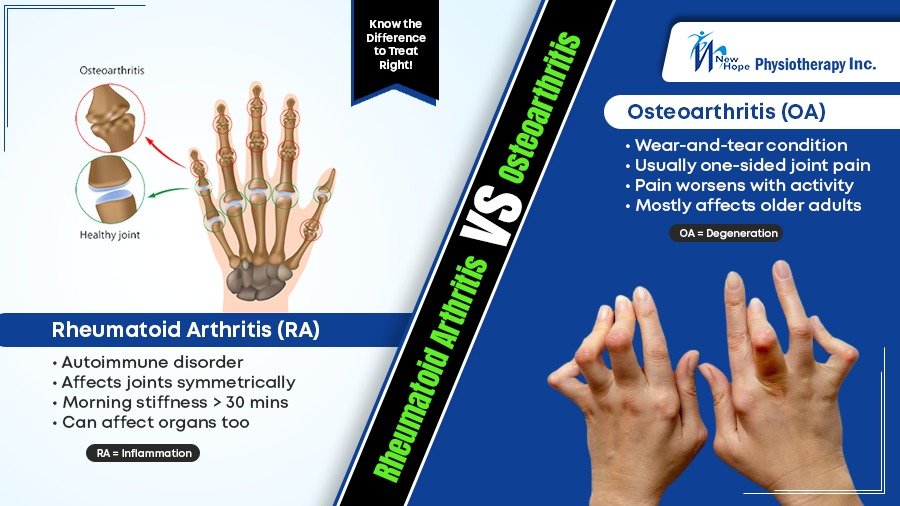
Rheumatoid Arthritis (RA) is an auto immune disease. The immune system of the body in this condition incorrectly attacks body joint tissues causing inflammation, joint pain, and damage of the tissues. The joints involved in this type of arthritis are usually symmetrical, in other words, the chances that your right wrist is affected and the left wrist is as well. Rheumatoid arthritis may never improve and may at times attack the inner organs such as the lungs and the heart.
What is Osteoarthritis?
People often describe osteoarthritis (OA) as a wear-and-tear disease. It takes place when protective cartilage that cushions the ends of the bones becomes worn during the course of time. In contrast to RA it tends to involve joint asymmetrically and more often in older adults. Osteoarthritis (OA) can affect any joint, but it most commonly targets the knees, hips, spine, and hands.
Also Read: What Should You Not Do After Cupping?
The main differences:
- Reason: RA is an autoimmune disease, whereas OA is a degenerative one.
- Development: People can acquire or develop rheumatoid arthritis (RA) at any age, while osteoarthritis (OA) typically affects individuals in old age.Symptoms: RA causes inflammation and systemic issues, whereas OA affects only the joints.
- Management: RA needs the use of immune-modulating medications; OA are pain relief and joint conserving.
Other possibilities, which are available under arthritis treatments, such as Rheumatoid arthritis treatment are medications that suppress the immune system, physical means of therapy, and even surgery to a certain extent. Osteoarthritis Treatment Brampton, on the other hand, would put greater emphasis on exercise protocols, joint injections, alteration of lifestyle and use of anti-inflammatory drugs.
Also Read: 10 Gentle Workouts to Help Lower Back Pain at Home
In case you have all symptoms of arthritis, like morning stiffness, swelling, and discomfort in joints, it is critical to turn to a specialist. It is worth considering visiting a credible arthritis clinic in Brampton, which will help determine the type of arthritis and start a personal treatment program to cope with the symptoms and better quality of life.
FAQs:
Q1. Is it possible to develop rheumatoid and osteoarthritis?
Yes, a person may have both conditions, but it is not frequent. This is known as secondary osteoarthritis where OA occurs in a joint which already has RA.
Q2. How can I be sure about the type of arthritis that I have?
Rheumatologist will test your health history, physically inspect you and possibly advise a blood test or an imaging procedure to differentiate between RA and OA depending on the symptoms of arthritis.
Q3. Does arthritis have a cure?
It is unfortunate that arthritis is incurable. Nevertheless, when diagnosed early and treated properly including through such choices as Rheumatoid arthritis treatment or Osteoarthritis Treatment Brampton, the progression can be considerably slowed down and the functioning enhanced.
Also Read: 5 Quick Home Remedies for Leg Cramp Relief and Prevention
Q4. What is the difference between rheumatoid arthritis and osteoarthritis?
Rheumatoid arthritis (RA) is an autoimmune disease where the immune system attacks the joints. Osteoarthritis (OA) is caused by wear and tear of the joints over time. RA causes inflammation, while OA happens because the joint cartilage breaks down.
Q5. Which is more painful, rheumatoid arthritis or osteoarthritis?
Both can be painful, but the pain feels different. Rheumatoid arthritis often causes swelling, stiffness, and pain in many joints. Osteoarthritis usually causes pain that gets worse with activity and improves with rest.
Q6. What are the common symptoms of rheumatoid arthritis?
Common symptoms include:
- Swollen and tender joints
- Morning stiffness lasting more than 30 minutes
- Fatigue
- Warm joints
- Pain in both sides of the body, such as both hands or both knees
Q7. What are the common symptoms of osteoarthritis?
Osteoarthritis symptoms may include:
- Joint pain during or after movement
- Stiffness after resting
- Reduced joint flexibility
- Grinding or clicking sounds in the joint
- Mild swelling around the affected joint
Q8. Can rheumatoid arthritis and osteoarthritis be treated?
Yes. While there is no complete cure for either condition, treatment can help reduce pain and improve movement. Treatment may include medication, physiotherapy, regular exercise, weight management, and healthy lifestyle changes.
Q9. Can physiotherapy help with rheumatoid arthritis and osteoarthritis?
Yes. Physiotherapy can help reduce pain, improve joint movement, increase muscle strength, and make daily activities easier. A physiotherapist can create a safe exercise program based on your condition and needs.
Q10. When should I see a healthcare professional for arthritis?
You should seek medical advice if you have ongoing joint pain, swelling, stiffness, or difficulty moving your joints. Early diagnosis and treatment can help protect your joints and improve your quality of life.
Conclusion
The initial stage of effective care is to know the distinction between RA and OA. Osteoarthritis or Rheumatoid Arthritis is a condition that should be treated early through an arthritis clinic in Brampton.
Also Read: 5 Common Types of Back Pain You Should Know
Gauravdeep Randhawa, Registered Physiotherapist
Gauravdeep Randhawa is a caring and experienced physiotherapist with over 17 years of experience helping patients recover and improve their quality of life.
She started her own practice in Canada in 2009 and has treated many patients with muscle, joint, sports, neurological, and pelvic health conditions. She has also owned and operated multidisciplinary clinics.
Gauravdeep is a Certified Manual Therapist and has completed training in Contemporary Medical Acupuncture and Pelvic Floor Therapy. She uses hands-on treatment, personalized exercise programs, and evidence-based care to support each patient’s recovery.
Her goal is to help people reduce pain, restore movement, improve function, and achieve long-term wellness in a comfortable and supportive environment.


Leave a Comment