
Welcome to New Hope Physiotherapy
- Brampton 905-846-4000
- Malton 905-364-3900
- Orangeville 519-217-9300
- admin@newhopephysio.com
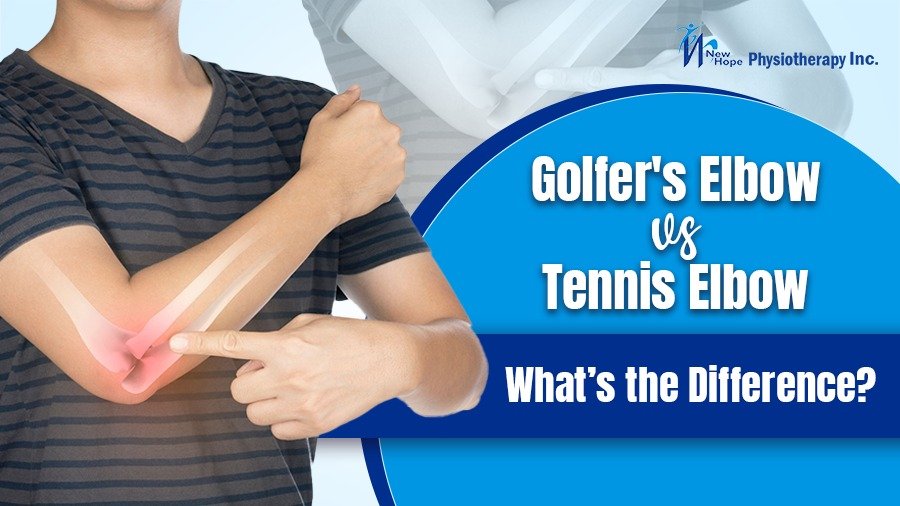
Golfer’s Elbow vs. Tennis Elbow: What’s the Difference?
 5 Aug 2025
- newhope
- 0 Comments
- 1783
Golfer’s Elbow vs. Tennis Elbow: What’s the Difference?
Introduction: With regard to repetitive strain damage of the elbow, two such usual conditions are confused normally; and yet, actually, they are quite not the same as one another. Both conditions, Golfer Elbow and Tennis Elbow. Although they cause elbow pain, they have different regions of the joint in which they occur and they individualize the people differently. Healthcare providers treat these two conditions separately because understanding their key differences is crucial for proper treatment and long-term recovery.
Also Read: Exploring the Latest Advances in Elbow Injury Treatment and Rehabilitation
The Terms Learnt
Repetitive motions like gripping and flexing the wrist can inflame the tendons inside the elbow, leading to golfer’s elbow, or medial epicondylitis. You do not have to be a golfer in order to develop it despite its name. Tasks such as weightlifting, throwing, and typing are all tasks that can cause this condition.
So what is tennis elbow? Otherwise known as lateral epicondylitis, the condition involves the tendons of the outside part of the elbow. It occurs in racquet sport, painting or plumbing, patterned by repetitive wrist and arm extension. Both conditions share similarities as overuse causes them, but they differ in the position and movement that trigger each one.
Also Read: 5 Quick Home Remedies for Leg Cramp Relief and Prevention
Diagnoses and types
The symptoms of the tennis elbow normally involve the pain and tenderness at the outer side of the elbow, forearm weakness, and difficulty in holding things. Comparably, Golfer Elbow brings pain on the inside of the elbow in some cases fired by the forearm.
Doctors usually diagnose these conditions through a physical exam and may recommend further imaging tests (such as X-rays or CT scans) to identify other sources of elbow pain.
Also Read: What is Acupuncture?
EPI Treatment and Healing
So, whether it is tennis elbow or golfer’s elbow, chances are that these conditions show a relatively good response to rest, ice therapy and over the counter pain relievers. Tennis elbow braces may relieve the pressure and give a chance to heal.
Both respond very well to physical therapy, and similar exercises treat both tennis and golfer’s elbow, focusing on strengthening the forearm and improving flexibility. To relieve inner elbow pain, specific stretches and eccentric loading are essential.
Seeking faster recovery is the motive people tend to find the answer to the question how to heal tennis elbow fast or how to fix golfers elbow fast. When conservative ones do not work, more sophisticated practices can be prescribed in such circumstances such as shockwave therapy, platelet rich plasma (PRP) injections or corticosteroids.
Also Read: 20 Common Injuries Treated by a Physiotherapist in Brampton
Conclusion
As you manage to determine whether you have a golfer’s elbow or tennis elbow, you will get on the proper healing pathway and minimise the chances of getting the long-term effects of this condition.
Also Read: 10 Gentle Workouts to Help Lower Back Pain at Home
Leave a Comment