
Welcome to New Hope Physiotherapy
- Brampton 905-846-4000
- Malton 905-364-3900
- Orangeville 519-217-9300
- admin@newhopephysio.com
How Shockwave Therapy Helps Plantar Fasciitis?
 21 Jul 2022
How Shockwave Therapy Helps Plantar Fasciitis?
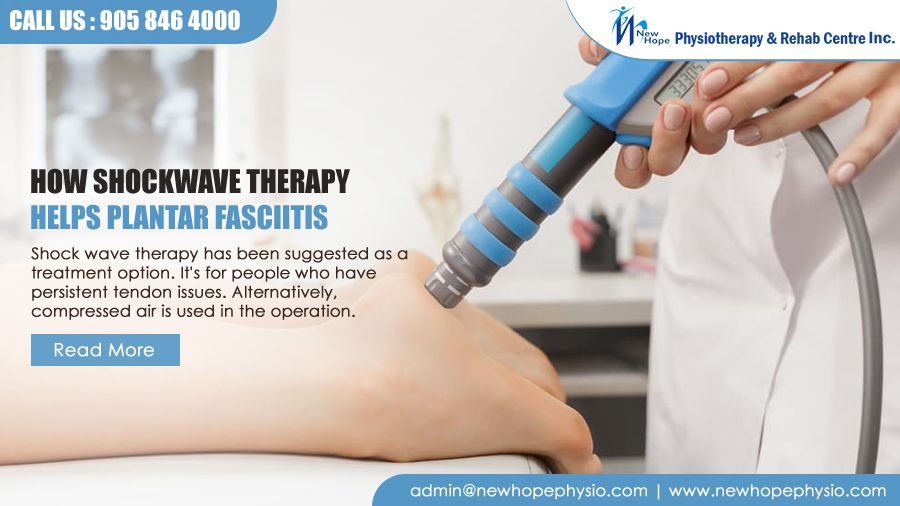
How Shockwave Therapy Helps Plantar Fasciitis? : Shock wave therapy has been suggested as a treatment option. It’s for people who have persistent tendon issues. Alternatively, compressed air is used in the operation. Electromagnetic pulses are also used to deliver shock waves. So it is to the body’s benefit in the treatment of several chronic illnesses.
Also Read : What Is Shockwave Therapy?
What Is Shockwave Therapy and How Does It Work?
A machine is used to give shockwave therapy benefits. It sends low-energy sound waves to the injured site through your skin. It’s been thoroughly researched. The National Institute for Clinical Excellence recommends it (NICE). It has been proved to alleviate pain and speed up the healing process. So our shockwave therapy in Brampton accomplishes this by:
- Increasing blood flow to the tissues in the immediate vicinity
- Stem Cells are responsible for inducing healing processes.
- Reduces the action of particular nerve fibres, resulting in a reduction in pain.
Also Read : What Is Shockwave Therapy Used For?
What Is Treatable?
Shockwave Therapy is effective in the treatment of:
- Heel Pain (plantar fasciitis)
- Injuries to the Achilles Tendon
- Stress Fractures in the Shins
- Mortons Neuroma
- Osteoarthritis
- Bone Healing That Isn’t Complete
Also Read : What Is Shockwave Therapy Workout And How Does It Work?
There are certain minuscule shockwave therapy side effects.
How Does It Work?
There are two types of shock wave treatment: high-energy and low-energy. Both of these kinds can utilised to treat various ailments.
Treatments with low-energy shock waves are provided in a course of three or more treatments. Low-energy shock waves are either not uncomfortable or only mildly painful.
The high-energy shock wave treatments, on the other hand, are provided in a single session. Treatments with high-energy shock waves are excruciatingly unpleasant. Frequently, some form of anaesthetic required.
Also Read : The Importance Of Shockwave Therapy In Modern Physiotherapy Treatment
What Shockwave Therapy Used For?
During the procedure, you will feel some discomfort. You ought to be able to deal with it.
- You may notice redness after the shockwave therapy cost.
- The area may experience bruising, swelling, and numbness.
- Within a week, these adverse effects should subside.
- This could happen before your next therapy in the shockwave therapy clinic.
A modest chance of tendon or ligament rupture exists. It can also cause soft tissue injury. This technique has been certified safe by the National Institute for Health and Care Excellence (NICE). As a result, each patient will monitored beforehand. Shockwave therapy reviews show that the success of the outcome can be determined.
According to studies, it has a probability of working up to 80% of the time.
Also Read : How Long Does It Take Until I Notice The Benefits Of Shockwave Therapy?
What is Plantar Fasciitis?
Plantar fasciitis of the foot treated with a conservative technique. It is through the heel that shockwaves transmitted. Its purpose is to help the inflammatory plantar fascia tissues repair. Mechanical high-energy sound waves are used in shockwave treatment. It works by increasing blood flow. So this treatment applied to the affected area. This done to hasten the healing process.
Also Read : Shockwave Therapy Treatment For Plantar Fasciitis
How Shockwave Therapy Helps Plantar Fasciitis?
Plantar fasciitis is a painful ailment that affects the soles of the feet. Overstretching or overuse causes the plantar fascia to become irritated. It hurts the heel and the bottom of the foot. Plantar fascia tears can occur as a result of repeated strain on the ligament. Also it causes discomfort and edema. It can make it difficult to walk.
One of the most common reasons for heel discomfort is this condition. It is more common in men and women in their forties and fifties. It can also happen to people who are always on their feet. It’s also good for people who participate in sports and athletics.
Also Read : Shockwave Therapy For Acute And Chronic Injuries
The Plantar Fascia’s Anatomy
The plantar fascia is a long, thin ligament that connects the heel to the toes. It can found on the bottom of the foot. It is responsible for the foot’s arch. So it begins at the heel bone and continues to the toes. Then separates in two.
It spreads out to cling to the toes. It performs the function of a shock absorber. So it helps to support your foot’s arch. Also works similarly to a bowstring. While walking, it stiffens your foot.
Also Read: 10 Gentle Workouts to Help Lower Back Pain at Home
Plantar Fasciitis Symptoms and Risk Factors
Plantar fasciitis characterized by a sharp pain in the heel. Also it’s worse first thing in the morning or after a long time of inactivity. It may get worse when you work out.
The following factors enhance your chances of developing plantar fasciitis. They are not the only risk factors, however:
- Being between the ages of 40 and 60 and having a flat foot
- High arch
- Atypical gait
- Carrying a few extra pounds being someone who works on their feet all-day
You might also feel some discomfort. So pain can occur if you have recently increased your typical activity levels. It can try a new sort of exercise.
Also Read : Shockwave Therapy In Abbotsford & Surrey
Who Isn’t a Candidate for Shock Wave Therapy?
The following are some of the contradictions:
- Pacemaker patients are those who have a pacemaker implanted in their chest.
- Patients who are using blood thinners
- Medicines that prevent blood clotting (such as Coumadin) are not eligible for ESWT.
- Patients suffering from tumours.
- ESWT not recommended for children and also pregnant women.
- Plantar fasciitis in its most severe form.
Accordingly, a Shockwave therapy machine not recommended for people who have acute plantar fasciitis. It shouldn’t be younger than four weeks. Other, moreover conservative therapy options should tried first. Extracorporeal shock wave therapy is being considered.
Also Read : Shockwave Therapy Treatment In Brampton Orangeville And Malton

Leave a Comment