

Welcome to New Hope Physiotherapy
- Brampton 905-846-4000
- Malton 905-364-3900
- Orangeville 519-217-9300
- admin@newhopephysio.com
Manual Therapy vs Massage Therapy: Exploring Differences & Benefits
 29 Mar 2024
- newhope
- 0 Comments
- 1838
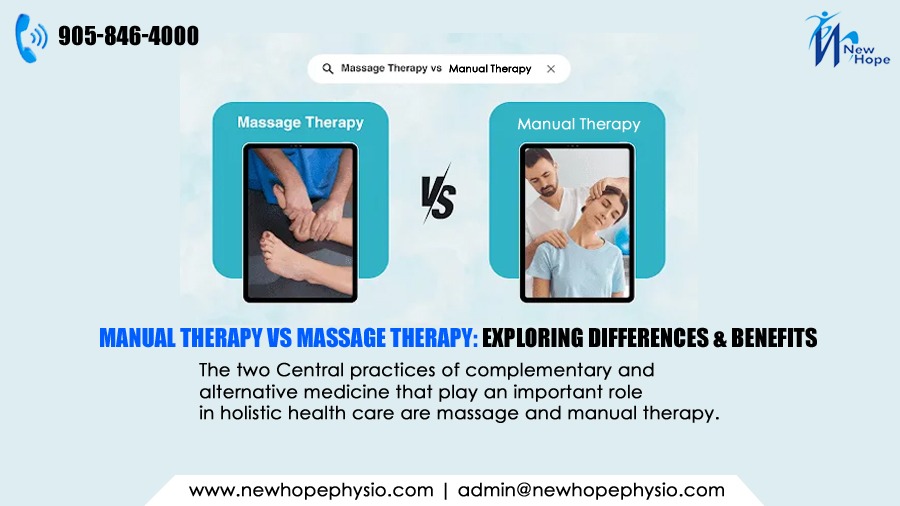
Manual Therapy vs Massage Therapy: Exploring Differences & Benefits
If you’ve ever booked a massage or seen a physiotherapist, you may have heard the terms “manual therapy” and “massage therapy” used almost interchangeably. But they’re actually quite different — and knowing the difference can help you choose the right treatment for what you’re dealing with.
Let’s break it down in plain, simple terms.
Also Read: 10 Gentle Workouts to Help Lower Back Pain at Home
The Simple Way to Think About It
- Manual therapy targets specific joints and tissues to fix a problem — it’s clinical and precise
- Massage therapy works on the soft tissues of the whole body — it’s therapeutic and restorative
Both involve hands-on treatment. Both can reduce pain. But they have different goals, techniques, and ideal uses.
What Is Manual Therapy?
Manual therapy is a clinical, hands-on treatment used by physiotherapists, chiropractors, and osteopaths.
It focuses specifically on joints, muscles, and connective tissue that aren’t working properly. The goal is to restore normal movement, reduce pain, and improve function.
Manual therapy is precise. It targets the exact area causing your problem — not the whole body.
Also Read: 5 Quick Home Remedies for Leg Cramp Relief and Prevention
Common manual therapy techniques include:
- Joint mobilisation — gentle movements to restore joint motion
- Joint manipulation — precise, quick movements to improve alignment
- Soft tissue mobilisation — working on muscles and connective tissue around a joint
- Myofascial release — releasing tension in the connective tissue (fascia)
- Nerve mobilisation — gentle techniques to free up irritated nerves
- Passive range of motion — moving a joint through its range while you relax
What Is Massage Therapy?
Massage therapy — also called soft tissue therapy — is a broader, more general treatment. A registered massage therapist uses touch, pressure, and rhythmic movements to work on your muscles, tendons, and ligaments.
Massage therapy is restorative. It helps your whole body relax, recover, and function better.
Common massage therapy techniques include:
- Swedish massage — long, flowing strokes for relaxation and circulation
- Deep tissue massage — firm pressure targeting deeper muscle layers
- Myofascial release — similar to manual therapy, targeting the fascia
- Trigger point therapy — focused pressure on specific tight spots in muscles
- Sports massage — tailored for athletes before or after activity
Manual Therapy vs Massage Therapy — Side by Side
| Manual Therapy | Massage Therapy | |
|---|---|---|
| Main goal | Restore joint and tissue function | Relax muscles and soft tissues |
| Who provides it | Physiotherapists, chiropractors, osteopaths | Registered massage therapists |
| Focus area | Specific joints or problem areas | Broader muscle groups and soft tissue |
| Approach | Clinical and targeted | Therapeutic and relaxing |
| Best for | Joint stiffness, injury, post-surgical rehab | Stress, tension, circulation, recovery |
| Techniques | Joint mobilisation, manipulation, nerve work | Swedish, deep tissue, trigger point |
| Part of a rehab plan? | Yes — core component | Often used as a complement |
The Benefits of Manual Therapy
1. Targeted Pain Relief
Manual therapy goes straight to the source of your pain. Whether it’s a stiff joint, a compressed nerve, or restricted connective tissue — targeted techniques address the specific structure causing the problem.
This leads to more direct and lasting pain relief than generalised treatment.
2. Better Joint Function
Stiff, restricted joints limit how freely you can move. Manual therapy restores normal joint movement by:
- Breaking down adhesions (internal scar tissue) that restrict movement
- Correcting muscular imbalances around the joint
- Improving joint lubrication and glide
People with arthritis, frozen shoulder, or chronic joint stiffness often notice significant improvement.
3. Supports Rehabilitation
After surgery or a serious injury, scar tissue forms and movement patterns change. Manual therapy:
- Minimises unhealthy scar tissue build-up
- Restores normal movement mechanics
- Supports faster, more complete recovery
It’s a core part of most post-surgical rehabilitation programmes.
4. Corrects Posture
Poor posture doesn’t just look bad — it causes real pain over time. Tight muscles, stiff joints, and spinal misalignment all contribute.
Manual therapy addresses the physical restrictions that make good posture difficult to maintain — allowing your body to naturally find better alignment.
Also Read: Shoulder Pain Solutions: 7 Essential Exercises for Quick Relief
5. Improves Sports Performance
Athletes use manual therapy to:
- Correct faulty movement patterns that increase injury risk
- Release tight muscles and joint restrictions that limit performance
- Speed up recovery between training sessions and competitions
- Get back to sport faster after injuries
The Benefits of Massage Therapy
1. Reduces Stress and Promotes Relaxation
This is massage therapy’s most well-known benefit — and it’s backed by science.
Massage lowers levels of cortisol (the stress hormone) and triggers the release of endorphins. The result is a deep sense of calm that benefits both your body and your mind.
2. 🩹 Manages Chronic Pain
Massage increases blood flow to painful areas. More blood flow means more oxygen and nutrients reaching damaged tissue — which speeds up healing and reduces pain.
Particularly helpful for:
- Tension headaches
- Neck and shoulder pain
- Lower back pain
- Fibromyalgia
3. ❤️ Improves Circulation
Working on soft tissue directly improves blood and lymphatic circulation throughout the body.
Benefits of better circulation include:
- Faster removal of metabolic waste from muscles
- More efficient delivery of oxygen and nutrients to cells
- Increased energy levels
- Faster recovery after exercise
4. 🤸 Increases Flexibility
Regular massage breaks down tight spots and adhesions in muscles and connective tissue. Over time this leads to:
- Greater range of motion
- Less stiffness in daily movement
- Better athletic performance
- Reduced injury risk
5. 🛡️ Supports Your Immune System
Research suggests that massage therapy may improve immune function by:
- Reducing stress hormones that suppress immunity
- Stimulating lymphatic flow — which carries immune cells through the body
- Improving overall physical and mental wellbeing
Which One Do You Need?
Here’s a simple guide to help you decide:
Choose Manual Therapy if you have:
- A specific joint that’s stiff or painful
- A diagnosed musculoskeletal condition (like a herniated disc or frozen shoulder)
- Nerve pain or referred pain down an arm or leg
- Post-surgical stiffness or restricted movement
- A sports injury affecting your performance or function
Choose Massage Therapy if you want:
- General relaxation and stress relief
- Relief from muscle tension and tightness
- Better circulation and recovery after exercise
- Complementary support alongside other treatments
- Help managing chronic muscle pain or headaches
💡 You don’t always have to choose just one. Many people benefit from both — massage therapy to manage tension and promote recovery, and manual therapy to address specific structural problems. Your physiotherapist or healthcare provider can advise on what combination makes sense for you.
Who Provides Each Treatment?
| Treatment | Who Provides It |
|---|---|
| Manual therapy | Physiotherapists, chiropractors, osteopaths |
| Massage therapy | Registered massage therapists (RMTs) |
Always ensure whoever you see is properly qualified and registered. Ask about their training and experience with your specific condition before booking.
Also Read: 5 Common Types of Back Pain You Should Know
5 FAQs:
1. Can I have manual therapy and massage therapy in the same session?
Yes — and it’s actually quite common. Many physiotherapists incorporate massage-like soft tissue techniques alongside joint mobilisation and other manual therapy work. Some clinics also have both physiotherapists and massage therapists on staff who collaborate on a patient’s care. The two approaches complement each other well — massage therapy loosens the soft tissue, which can make joint-focused manual therapy more effective.
2. Will either treatment hurt?
Manual therapy can cause mild discomfort — particularly when mobilising a stiff joint or working on restricted connective tissue. It should never be severely painful, and a good therapist will always work within your tolerance. Some soreness the day after is normal and usually settles quickly. Massage therapy is generally more comfortable, though deep tissue work can be intense in very tight areas. Always communicate with your therapist about your comfort level — they will adjust accordingly.
3. How many sessions of each will I need?
It depends on your condition and goals. For a specific injury or joint problem, manual therapy typically forms part of a structured treatment plan — often 6 to 12 sessions to start. Massage therapy can be used more flexibly — some people have it regularly as part of a wellness routine, while others use it during specific periods of high stress or physical demand. Your physiotherapist or massage therapist will give you a clearer recommendation after assessing your situation.
4. Is massage therapy just for relaxation, or can it treat real medical problems?
Massage therapy is far more than just relaxation — though relaxation is a genuine therapeutic benefit in itself. It is a legitimate treatment for chronic muscle pain, tension headaches, circulation problems, post-injury recovery, anxiety, and more. Registered massage therapists are trained healthcare professionals, not just wellness providers. If you have a specific physical complaint, massage therapy can absolutely be part of a clinically appropriate treatment plan.
5. Are manual therapy and massage therapy covered by insurance?
In many cases, yes. Physiotherapy — which includes manual therapy — is covered by most private health insurance plans in Canada. Registered massage therapy is also covered by many plans, though the level of coverage varies. It’s always worth checking your specific plan before booking, as coverage limits, co-pays, and referral requirements differ between providers. Some plans cover a set number of sessions per year for each discipline separately.
Final Thoughts
Both manual therapy and massage therapy have a genuine and important place in healthcare. They’re not competing treatments — they’re complementary ones.
If you’re dealing with a specific injury, joint problem, or functional limitation, manual therapy is likely your best starting point. If you’re managing stress, chronic muscle tension, or want to support your overall recovery and wellbeing, massage therapy is an excellent choice.
And if you’re not sure which one you need? Talk to a qualified physiotherapist. They’ll assess your situation and point you in exactly the right direction.
Gauravdeep Randhawa, Registered Physiotherapist
Gauravdeep Randhawa is a caring and experienced physiotherapist with over 17 years of experience helping patients recover and improve their quality of life.
She started her own practice in Canada in 2009 and has treated many patients with muscle, joint, sports, neurological, and pelvic health conditions. She has also owned and operated multidisciplinary clinics.
Gauravdeep is a Certified Manual Therapist and has completed training in Contemporary Medical Acupuncture and Pelvic Floor Therapy. She uses hands-on treatment, personalized exercise programs, and evidence-based care to support each patient’s recovery.
Her goal is to help people reduce pain, restore movement, improve function, and achieve long-term wellness in a comfortable and supportive environment.
Medical Disclaimer:
This content is for general information only and is not a substitute for professional medical advice, diagnosis, or treatment. Please consult a qualified healthcare professional to determine which therapy is right for you.


Leave a Comment