
Welcome to New Hope Physiotherapy
- Brampton 905-846-4000
- Malton 905-364-3900
- Orangeville 519-217-9300
- admin@newhopephysio.com
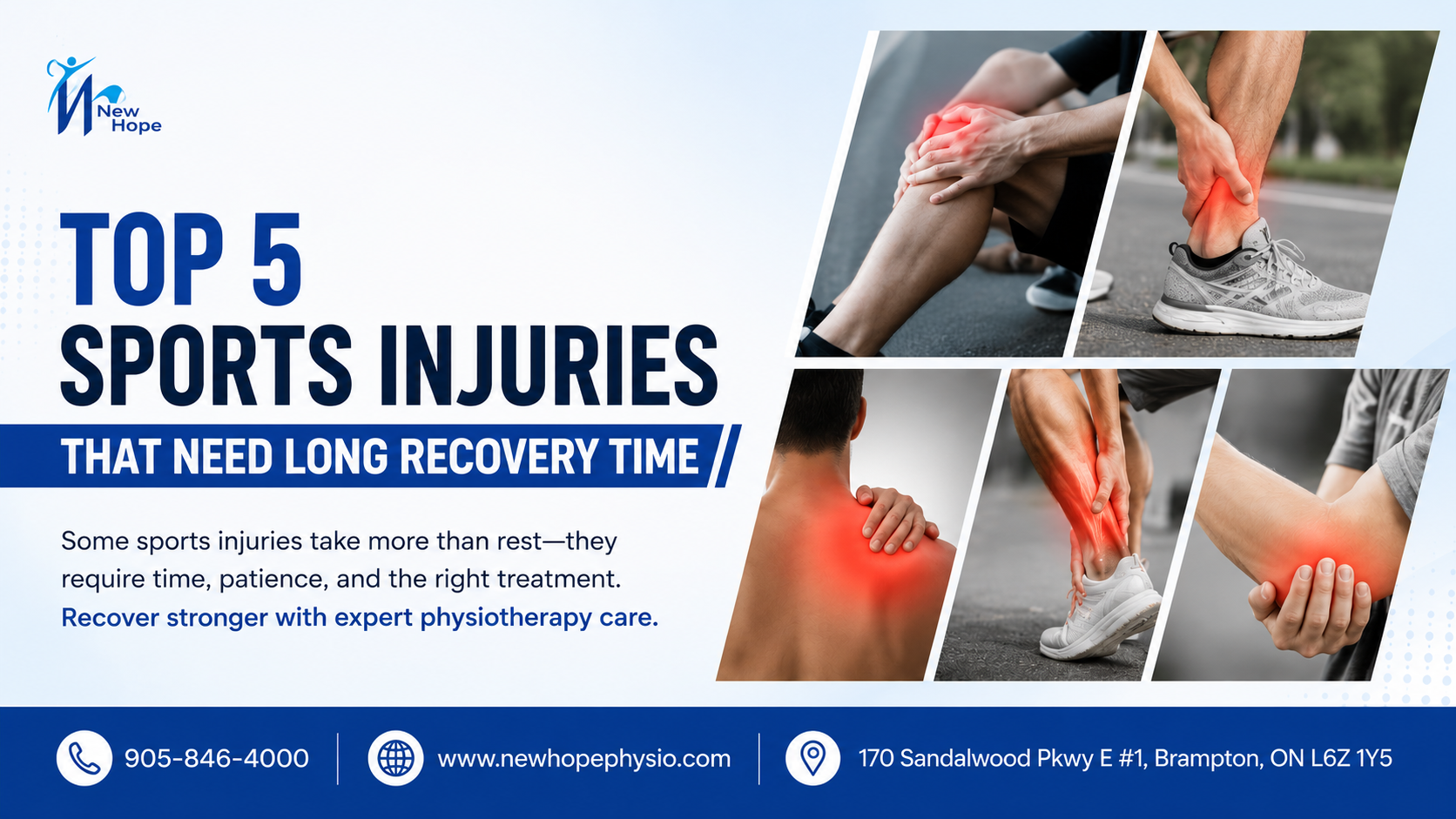
Top 5 Sports Injuries That Need Long Recovery Time
 11 May 2026
- newhope
- 0 Comments
- 507
Top 5 Sports Injuries That Need Long Recovery Time
Sports injuries are one of those things you think will not happen to you until they do. And then suddenly you are sitting there with an ankle wrapped up or a knee that feels strange and you are wondering how serious it actually is.
Some injuries are small. You rest, maybe ice it, complain a little, and in a few days you are okay.
But some are not like that. Some sports injuries take weeks, months, sometimes even longer before you feel normal again. Not just “I can walk” normal, but actually normal. Like running, jumping, turning, lifting, playing without thinking about it every two seconds.
That is the part people do not always talk about. Recovery is not just pain going away. It is trust coming back too.
And honestly, this is where sports injury physiotherapy starts to make sense. Not because it magically fixes everything overnight, but because it gives the recovery some direction. Otherwise you are just guessing, and most of us are bad at guessing when we are impatient.
Also Read: How Sports Physiotherapy Helps You Bounce Back Stronger After Injuries
When an Injury Feels Fine… But Not Really
This is probably the most annoying stage.
You feel better. Sort of. The swelling is down, the pain is not as bad, and you start thinking maybe you can go back to your sport. Then you try one quick movement and your body basically says, no, not yet.
I have done that before. Not with anything dramatic, but enough to learn that “less pain” does not always mean “healed.”
Long recovery sports injuries usually involve ligaments, tendons, joints, or bones. These areas can be slow. Really slow. And if you rush them, they can get irritated again.
That is why people end up searching things like sports physiotherapy near me or Sports injury Clinic after a few weeks of trying to handle it themselves. It is not always because the injury is terrible. Sometimes it is because the recovery feels confusing.
New Hope Physiotherapy talks a lot about sports physiotherapy, rehab, movement, and injury treatment in a practical way. Their locations around Brampton, Mississauga/Malton, and Orangeville are useful for people looking for sports physiotherapy Brampton, sports physiotherapy Mississauga, or Sports Physiotherapy Orangeville without making it a whole big thing.
Also Read: 10 Gentle Workouts to Help Lower Back Pain at Home
1. ACL Tears
ACL injuries are one of the big ones. People hear “ACL tear” and usually know it is serious.
This usually happens in sports where you’re moving fast and changing direction a lot. You plant your foot, turn the wrong way, land a bit awkwardly, or stop too suddenly — and the knee takes the hit. Soccer, basketball, football, skiing, all those kinds of sports.
The weird thing is, sometimes the moment is fast. One second you are moving, next second your knee feels wrong. Some people feel a pop. Some just know something is off. Then comes swelling, pain, and that unstable feeling. Like the knee is not fully on your side anymore.
This one can take a long time to come back from, especially after surgery. It is not just “heal the ligament and done.” Your leg feels weaker, your balance can be off, and honestly, trusting the knee again is a whole thing by itself.
And confidence matters more than people think. You can have a knee that looks okay on paper but still feel nervous making a sharp turn. That is where physiotherapy for sports injuries helps. Small exercises, slow progress, checking how you move. It can feel boring. Actually, it often is boring. But boring works sometimes.
Also Read: 5 Quick Home Remedies for Leg Cramp Relief and Prevention
2. Achilles Tendon Rupture
The Achilles tendon is easy to ignore until it is injured. Then suddenly every step reminds you it exists.
An Achilles rupture usually happens during a quick push-off, a jump, or a run. Some people describe it like getting hit behind the ankle. Weird comparison, but apparently that is pretty close to how it feels.
This injury takes time because the Achilles is involved in so much. Walking, climbing stairs, standing on your toes, running, jumping. Even simple things feel different for a while.
The hard part is that recovery may look like it is going well, but the tendon still needs time. Calf strength does not just return because you want it to. Balance is weird too. You may feel lopsided, even if nobody else notices.
With this one, Sports injury treatment usually needs a careful plan. Rest, medical care if needed, then strengthening, mobility work, and slow return to activity. Slow. That word again. Nobody likes it, but it keeps showing up.
Also Read: 5 Common Types of Back Pain You Should Know
3. Rotator Cuff Tears
Shoulder injuries are sneaky.
You don’t realize how much your shoulder does until it starts hurting. Reaching up, putting on a jacket, carrying a bag, even trying to sleep on that side — suddenly all of it becomes annoying. And sleeping with shoulder pain? That gets old very fast.
This kind of shoulder injury shows up a lot in sports where you keep using your arm overhead — baseball, tennis, volleyball, swimming, that sort of thing. Gym workouts can cause it too. Sometimes the pain starts small, so people keep going and think it will settle on its own. Then it slowly gets worse.
A rotator cuff injury can feel like a weak shoulder, a dull ache, sharp pain when you lift, or just a shoulder that is not moving properly. Sometimes it clicks. Sometimes it feels tired all the time.
Recovery can be slow because the shoulder is complicated. It moves in so many directions, which is great until something goes wrong.
Sports Physiotherapy for shoulder injuries might include mobility work, strengthening, posture stuff, and learning how to move without irritating it again. It is not always a straight line. One day better, next day stiff again. That happens.
Also Read: Shoulder Pain Solutions: 7 Essential Exercises for Quick Relief
4. Stress Fractures
Stress fractures are frustrating because there may be no big injury moment.
No fall. No collision. No dramatic story.
Just pain that slowly gets worse.
Usually it starts during activity. Maybe running, jumping, or training. Then it starts earlier in the workout. Then it hangs around after. At some point you realize this is not just soreness.
Stress fractures can happen when you push your body faster than it’s ready for. More running, more training, less rest — that kind of thing. Bad shoes or hard surfaces can add to it too, and sometimes it’s just the way someone moves.
The thing with stress fractures is you really cannot just push through them. Bone needs time. And if you keep loading it, recovery can drag on longer.
A Sports injury Clinic can help figure out what is going on and also why it happened. Because resting is one part, but if you go back to the exact same routine, same training, same habits, it may come back. Not always, but it can.
Also Read: What Should You Not Do After Cupping?
5. Severe Ankle Sprains
Ankle sprains get brushed off way too much.
People say, “It is just a sprain,” like that means it is nothing. But a bad ankle sprain can mess you up for a long time. The ligaments can be stretched or torn, the swelling can be ugly, and the ankle may feel weak or shaky afterward.
And because ankles are used constantly, you notice it all the time. Stairs. Walking on uneven ground. Turning quickly. Getting out of the car. Random little things.
With a bad ankle sprain, a few days of rest usually is not enough. You may need a brace, some simple strength and balance work, and honestly, just a slower return than you were hoping for. Balance work especially feels silly until you realize your ankle actually needs it.
Sports injury physiotherapy can help here, not just for the pain, but for getting the ankle steady again. Otherwise, it’s easy to keep rolling the same ankle over and over. That cycle is common. Very common.
Also Read: 36 questions should I ask a Physiotherapist?
So, What Is the Most Common Sports Injury?
People ask this a lot: What is the most common sports injury?
Honestly, it depends on the sport. But sprains and strains are way up there. Ankle sprains are probably one of the most familiar ones. Muscle strains too, especially hamstrings, calves, groin, and lower back.
But common does not mean harmless. That is the thing I keep coming back to.
A common injury can still become a long recovery if it is ignored or rushed. And a “small” injury can turn into something bigger when you keep testing it before it is ready.
For anyone looking for sports physiotherapy near me, the main thing is to find someone who looks at how you move, not just where it hurts. New Hope Physiotherapy offers sports physiotherapy and related treatments like manual therapy, exercise rehab, and other support depending on the injury. It is not about making it sound fancy. It is just useful to have a plan.
Also Read: Sciatica vs Hamstring Pain: What You Need to Know
FAQs
1. What sports injuries take the longest to recover from?
ACL tears, Achilles ruptures, rotator cuff tears, stress fractures, and severe ankle sprains can all take a long time. Usually months, not days.
2. What is the most common sports injury?
Sprains and strains are very common. Ankle sprains are probably one of the most common ones people deal with.
3. When should I see a physiotherapist for a sports injury?
If pain is not improving, swelling stays around, or movement feels off, it is probably worth getting checked.
4. Is sports injury physiotherapy only for athletes?
No. You can be a runner, weekend soccer player, gym person, or just someone who got hurt being active.
5. Can rest fix a sports injury?
Sometimes. But rest does not always rebuild strength, balance, or movement. That is where rehab helps.
6. Why does my injury still feel weird after the pain is gone?
Because pain can settle before your body is fully ready. Strength and control may still need work.
7. Can I return to sport once I feel better?
Maybe, but feeling better is not the only thing. You need to move well and not keep re-injuring the same area.
8. What happens during sports physiotherapy?
Usually an assessment, some movement testing, treatment if needed, and exercises you can actually build on.
9. Do ankle sprains need physiotherapy?
Mild ones may not. But severe or repeated sprains often do, especially if the ankle feels unstable.
10. How do I find a good Sports injury Clinic?
Look for a place that treats sports injuries often, explains things clearly, and does not rush you back too fast.
Also Read: Before Cupping vs. After Cupping: Real-Life Experiences
Conclusion
Long recovery sports injuries are frustrating in a way that is hard to explain unless you have had one. They interrupt your routine. They make simple things feel annoying. And they make you realize how much you took normal movement for granted.
The big lesson, I guess, is not to rush. Or at least try not to. Most of us rush anyway.
Pain going away is good, but it is not the whole recovery. Strength, balance, mobility, confidence — all of that matters too.
Whether someone goes to New Hope Physiotherapy or another trusted clinic nearby, having proper guidance can make the whole process feel less random. Not easy, exactly. But less like guessing. And when you are trying to get back to your sport, that helps more than people think.
Also Read: Frozen Shoulder vs. Rotator Cuff Tear: Key Differences and Symptoms
Gauravdeep Randhawa, Registered Physiotherapist
Gauravdeep Randhawa is a caring and experienced physiotherapist with over 17 years of experience helping patients recover and improve their quality of life.
She started her own practice in Canada in 2009 and has treated many patients with muscle, joint, sports, neurological, and pelvic health conditions. She has also owned and operated multidisciplinary clinics.
Gauravdeep is a Certified Manual Therapist and has completed training in Contemporary Medical Acupuncture and Pelvic Floor Therapy. She uses hands-on treatment, personalized exercise programs, and evidence-based care to support each patient’s recovery.
Her goal is to help people reduce pain, restore movement, improve function, and achieve long-term wellness in a comfortable and supportive environment.
Leave a Comment