

Welcome to New Hope Physiotherapy
- Brampton 905-846-4000
- Malton 905-364-3900
- Orangeville 519-217-9300
- admin@newhopephysio.com
How Shockwave Therapy Is Transforming Sports Injury Recovery
 24 May 2023
- newhope
- 0 Comments
- 1157
How Shockwave Therapy Is Transforming Sports Injury Recovery
Sports injuries are more than just physical setbacks. They disrupt training, threaten careers, and take a real mental toll. The longer recovery takes, the harder it becomes to stay motivated and maintain the fitness you’ve worked so hard to build.
Shockwave therapy is changing what’s possible for injured athletes. It speeds up healing, reduces pain, and gets people back to their sport faster — without surgery or long recovery periods.
Here’s everything you need to know about this powerful treatment and why it’s becoming a go-to option in sports medicine.
Also Read: 11 Powerful Solutions for Sciatica Pain Relief You Need to Try
What Is Shockwave Therapy?
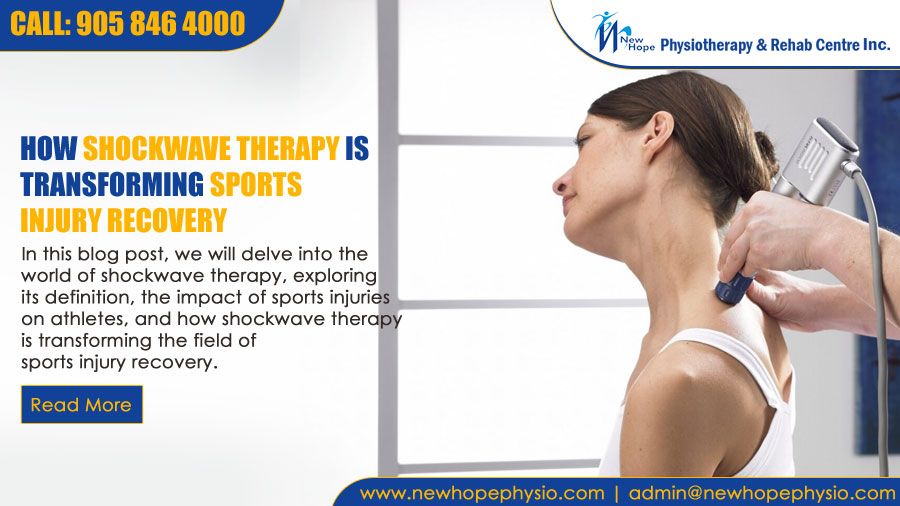
Shockwave therapy uses high-energy sound waves (called acoustic waves) to treat injured soft tissue, tendons, and bones. A handheld device is placed on the skin over the injured area and delivers these waves deep into the tissue.
It sounds intense — but it’s actually non-invasive, doesn’t require anaesthesia, and is typically done in a clinic in under 30 minutes.
Two Types of Shockwave Treatment:
| Type | How It Works | Best For |
| Focused shockwave | Concentrates energy precisely on a specific, targeted area | Deep-seated injuries — tendinitis, bone stress, nerve-related conditions |
| Radial shockwave | Spreads energy more broadly across a wider area | Surface-level conditions — plantar fasciitis, large muscle areas, general tendon pain |
Your physiotherapist will choose the right type based on your injury, its depth, and what needs to be treated.
Also Read: 10 Gentle Workouts to Help Lower Back Pain at Home
How Does Shockwave Therapy Actually Work?
When the sound waves reach injured tissue, they trigger a series of changes at the cellular level. This is what makes the treatment so effective — it doesn’t just manage symptoms, it stimulates the body to actually heal.
What Happens in the Tissue:
- Microtrauma is created — tiny, controlled damage that activates the body’s repair response
- Blood flow increases — delivering more oxygen and nutrients to the injured area
- Growth factors are released — proteins that signal tissue cells to regenerate
- Scar tissue breaks down — allowing new, healthy tissue to replace it
- Pain signals are reduced — shockwaves interrupt the nerve pathways that carry pain
- Endorphins are triggered — the body’s natural pain-relieving chemicals
Think of it like jump-starting a stalled healing process. Many chronic injuries get ‘stuck’ because the body’s natural repair response has switched off. Shockwave therapy switches it back on.
Sports Injuries Shockwave Therapy Can Treat
Shockwave therapy is effective for a wide range of sports injuries — particularly chronic conditions involving tendons, fascia, and bones that haven’t responded well to other treatments.
| Condition | Where It Hurts | Who Gets It |
| Plantar fasciitis | Bottom of the heel and foot | Runners, hikers, people on their feet all day |
| Achilles tendinopathy | Back of the ankle and lower calf | Runners, basketball and football players |
| Patellar tendinopathy (Jumper’s knee) | Just below the kneecap | Volleyball, basketball, and jumping athletes |
| Tennis elbow (lateral epicondylitis) | Outer side of the elbow | Racquet sports, golfers, manual workers |
| Golfer’s elbow (medial epicondylitis) | Inner side of the elbow | Golfers, climbers, overhead athletes |
| Rotator cuff tendinopathy | Deep in the shoulder | Swimmers, throwers, overhead sport athletes |
| IT band syndrome | Outer knee and thigh | Runners and cyclists |
| Calcific tendinitis | Shoulder — calcium deposits in tendon | Middle-aged athletes and active adults |
| Shin splints (tibial stress) | Front of the lower leg | Runners, military personnel, dancers |
| Hip flexor tendinopathy | Front of the hip | Sprinters, cyclists, kickers |
Shockwave therapy tends to work especially well for chronic conditions — injuries that have been present for 3 months or more and haven’t responded well to rest, stretching, or standard physiotherapy alone.
The Key Benefits of Shockwave Therapy for Athletes
- Faster Recovery
This is the benefit athletes care about most. Shockwave therapy stimulates the body’s healing processes at a cellular level — meaning tissue repair happens faster than it would naturally.
Also Read: 5 Quick Home Remedies for Leg Cramp Relief and Prevention
For conditions like Achilles tendinopathy or plantar fasciitis, recovery with shockwave therapy often takes weeks rather than months.
- Real, Lasting Pain Relief
Shockwave therapy doesn’t just mask pain. It addresses the tissue damage and nerve sensitivity that cause it. Most patients report significant pain reduction after just 3 to 5 sessions — and results tend to hold long-term.
- Breaks Down Scar Tissue
Old injuries often leave scar tissue behind. Scar tissue is less flexible, weaker, and more prone to re-injury than healthy tissue. Shockwave therapy breaks down this tissue and stimulates healthy regeneration in its place.
- Non-Invasive — No Surgery, No Needles
Shockwave therapy is performed externally. Nothing enters the body. There are no incisions, no injections, and no anaesthesia. This dramatically reduces risk and recovery time compared to surgical alternatives.
- Avoids Surgery in Many Cases
For conditions like calcific tendinitis and plantar fasciitis, shockwave therapy has helped many athletes avoid surgery entirely. Research shows it produces comparable or superior outcomes to surgical intervention for several chronic tendon conditions.
- Minimal Downtime
Most athletes can continue light training or daily activity between shockwave sessions. Unlike surgery or immobilisation, it doesn’t require you to stop moving completely. Your physiotherapist will advise on what activity is appropriate during your course of treatment.
- Can Be Combined with Other Treatments
Shockwave therapy works well alongside physiotherapy exercises, manual therapy, and strength and conditioning programmes. In most cases, it’s used as part of a broader rehabilitation plan — not as a standalone treatment.
Also Read: 5 Common Types of Back Pain You Should Know
| Benefit | What It Means for Athletes |
| Faster healing | Return to training sooner — weeks instead of months for many conditions |
| Pain reduction | Compete and train with less pain during and after recovery |
| Scar tissue breakdown | Better tissue quality, more flexibility, lower re-injury risk |
| Non-invasive | No surgical risks, no anaesthesia, no long post-operative recovery |
| Surgery avoidance | Many athletes avoid operations they were told they needed |
| Minimal downtime | Continue light activity between sessions — no forced rest |
| Combination-friendly | Works well with physio exercises, strength work, and manual therapy |
What to Expect During Shockwave Therapy
First-timers are often surprised by how straightforward the treatment is. Here’s what a typical course of shockwave therapy looks like.
Before Your First Session:
- Your physiotherapist assesses your injury, takes a history, and confirms that shockwave therapy is appropriate
- Imaging (ultrasound or MRI) may be needed to confirm the diagnosis and guide treatment
- Any recent corticosteroid injections in the same area may mean delaying shockwave therapy
During the Session:
- The skin over the injury is cleaned and gel is applied — similar to an ultrasound scan
- The handheld shockwave device is placed on the skin and moved over the treatment area
- You will feel pressure, vibration, and possibly mild discomfort — particularly over sore spots
- Each session typically lasts 10 to 20 minutes
After the Session:
- Mild soreness or aching in the treated area is normal for 24 to 48 hours
- Avoid anti-inflammatory medications immediately after treatment — they can blunt the healing response
- Ice can be used if soreness is significant
- Most people notice gradual improvement over the following days and weeks
How Many Sessions Will You Need?
| Condition | Typical Number of Sessions | Session Frequency |
| Plantar fasciitis | 3 to 5 sessions | Once per week |
| Achilles tendinopathy | 3 to 6 sessions | Once per week |
| Tennis or golfer’s elbow | 3 to 5 sessions | Once per week |
| Calcific tendinitis | 3 to 5 sessions | Once per week |
| Patellar tendinopathy | 4 to 6 sessions | Once per week |
| Rotator cuff tendinopathy | 4 to 6 sessions | Once per week |
Results are cumulative. Most people notice gradual improvement across the course of treatment, with the full benefit often appearing 6 to 8 weeks after the final session as the tissue continues to heal.
Real-Life Results — Athletes Who Chose Shockwave Therapy
Research and clinical data support shockwave therapy. But real-life outcomes are what matter most to athletes facing a potential injury setback.
Tennis Player — Chronic Tennis Elbow: After months of pain, rest, and cortisone injections that only provided temporary relief, a competitive tennis player tried shockwave therapy as a last option before considering surgery. After 4 sessions, pain was significantly reduced. Within 8 weeks, they were back training at full intensity.
Marathon Runner — Plantar Fasciitis: A marathon runner with severe heel pain had tried orthotics, stretching, and anti-inflammatories for over a year. Shockwave therapy resolved the pain over a 5-session course. They completed their next marathon without foot pain for the first time in 18 months.
Recreational Footballer — Achilles Tendinopathy: A club footballer had persistent Achilles pain that stopped them from playing for two seasons. Three months of standard physiotherapy had limited effect. After 5 shockwave sessions combined with a loading programme, they returned to full match play within 10 weeks.
These aren’t isolated cases. Shockwave therapy consistently produces strong results for athletes who use it correctly — with the right diagnosis, the right technique, and the right rehabilitation plan around it.
The Future of Shockwave Therapy in Sports Medicine
Shockwave therapy is still a relatively new treatment in sports medicine — and research is accelerating. Here’s what’s on the horizon.
- Combination protocols — shockwave paired with PRP (platelet-rich plasma) injections for even faster tissue healing
- Preventive applications — using shockwave therapy before injuries become chronic, rather than waiting
- Improved targeting technology — real-time ultrasound imaging guidance for more precise treatment delivery
- Expanding conditions — growing evidence for using shockwave in bone healing, nerve injuries, and muscle conditions
- Greater accessibility — as technology advances, shockwave devices are becoming more widely available in clinics
The field of sports medicine is embracing shockwave therapy because of one simple reason: it works. As more research confirms its effectiveness, it will continue to become a standard part of sports injury care.
5 Frequently Asked Questions About Shockwave Therapy
- Does shockwave therapy hurt?
Most people describe it as feeling like a rapid tapping or vibrating pressure — uncomfortable in sore areas but generally well tolerated. Some spots may be more sensitive than others. The discomfort is usually brief and subsides quickly after the device moves to a different area. Most patients manage fine without any pain relief beforehand. If you find the sensation too intense, your physiotherapist can adjust the intensity immediately. Any post-treatment soreness typically resolves within 24 to 48 hours.
- How quickly will I see results from shockwave therapy?
Results are usually gradual rather than immediate. Some people notice improvement after the first or second session. More commonly, significant improvement becomes apparent after 3 to 5 sessions — and the healing process continues for several weeks after the final treatment. The full benefit of a course of shockwave therapy is often seen 6 to 8 weeks after completion. Patience is important — the treatment is stimulating a biological healing process, which takes time.
- Can I keep training while having shockwave therapy?
In most cases, yes — with some modification. Your physiotherapist will advise on what you can and can’t do between sessions. Light activity is usually fine. High-impact training or activities that significantly load the treated area may need to be reduced temporarily. This varies by condition and by how far into the treatment course you are. Most athletes find this significantly less disruptive than surgical recovery — which typically requires weeks of complete rest.
- Is shockwave therapy better than cortisone injections for tendon pain?
For most chronic tendon conditions, yes — and increasingly, the research supports this. Cortisone injections provide fast short-term pain relief but do not stimulate healing. In fact, repeated injections can weaken tendon tissue over time. Shockwave therapy takes longer to produce results but addresses the underlying tissue pathology and stimulates genuine healing. For chronic conditions like Achilles tendinopathy, plantar fasciitis, and calcific tendinitis, shockwave therapy tends to produce better long-term outcomes than cortisone injections.
- Who is shockwave therapy NOT suitable for?
While shockwave therapy is safe for most people, there are certain contraindications. It should not be used over areas with blood clotting disorders, active infections or open wounds, malignant tumours, or directly over growth plates in children and adolescents. It is also not recommended during pregnancy, over areas with a cardiac pacemaker or other electronic implants, or directly over the lungs or skull. Your physiotherapist will screen for all of these before treatment begins. Always disclose your full medical history before starting any new treatment.
Final Thoughts
Sports injuries don’t have to mean months on the sidelines, surgery, or accepting that the pain is just something you live with now.
Shockwave therapy offers something genuinely different — a treatment that works with your body’s own healing mechanisms to repair tissue, reduce pain, and restore function. For many athletes, it changes the outcome entirely.
If you’re dealing with a stubborn sports injury that hasn’t responded to rest or standard treatment, shockwave therapy is worth exploring. Talk to a qualified physiotherapist and find out whether it’s right for your condition.
Leave a Comment