
Welcome to New Hope Physiotherapy
- Brampton 905-846-4000
- Malton 905-364-3900
- Orangeville 519-217-9300
- admin@newhopephysio.com
Laser Therapy : Get To Know The Purpose, Procedure, and Risks
 25 Aug 2022
Laser Therapy : Get To Know The Purpose, Procedure, and Risks
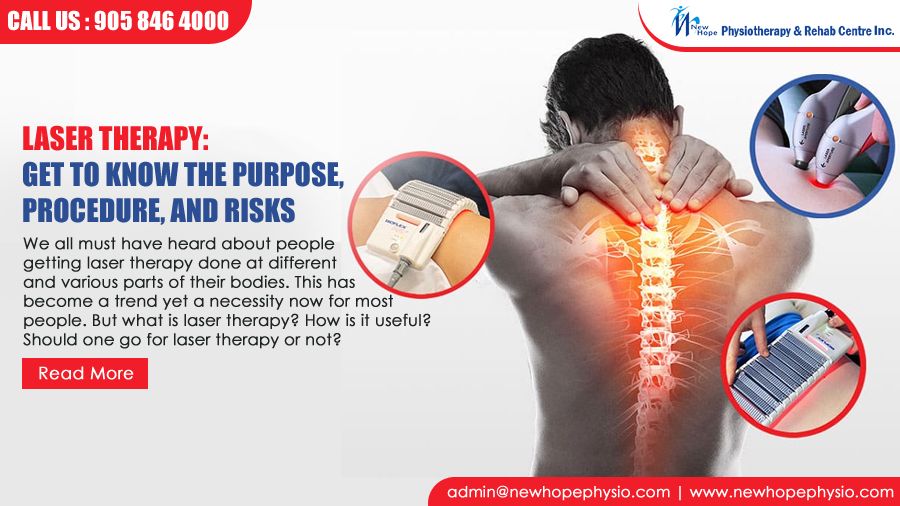
We all must have heard about people getting laser therapy done at different and various parts of their bodies. This has become a trend yet a necessity now for most people. But what is laser therapy? How is it useful? Should one go for it or not?
Let’s get our answers now
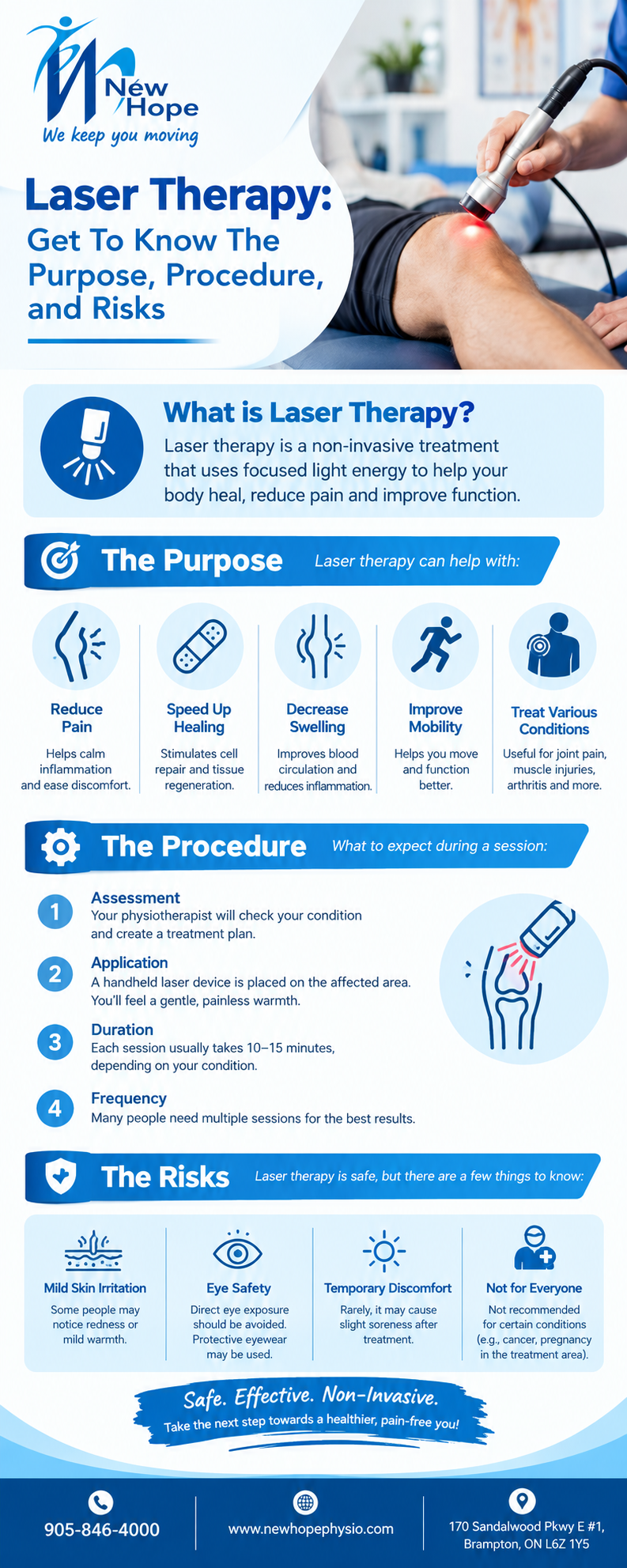
Do you know the word ‘laser’ is an acronym; it has a complete form. LASER stands for Light Amplification by Stimulated Emission of Radiation. Laser therapy is a part of medical treatment. This involves the use of focused light, which is a powerful beam.
In this therapy, the therapist or the surgeon has to focus on smaller areas so that less damage is in the surrounding tissue. Unlike traditional surgery, it can induce less pain, swelling, and scarring.
Also Read : Is Low-Level Laser Therapy Right For You?
Uses of Laser Therapy
It can be functional in the following domains:
- Eliminating kidney stones
- Alleviating cancer symptoms
- Restoring a detached retina
- Improving vision
- Treating pain, including back nerve pain
It is one of the crucial techniques for treating cancer, including cervical cancer, penile cancer, vaginal cancer, and vulvar cancer.
Apart from that, it is also a helpful cosmetic, which includes removing warts, moles, birthmarks, removing hair, and removing tattoos. It is in effect in the cosmetic industry.
Also Read : How Does Laser Therapy Work For Pain?
Also, helps relieve pain. Moreover, it is also effective in physiotherapy, wherein low-level laser therapy (LLT) is helpful for concerns related to musculoskeletal conditions.

The procedure
It involves varied techniques from procedure to procedure as to where the therapy will be applied. For example, if it has to be applied in cosmetics, the lasers are opposite directly on the skin. In the case of tumours then, an endoscope comes to use.
Also Read : World Mental Health Day 2024
Types of Laser Therapies
It can be of varied types, including:
- Refractive Eye Surgery
- Tooth Whitening
- Cosmetic Scar
- Cataract
- Tumor Removal
Risks in Laser Therapy
No doubt, it is in trend these days. A lot of people are going to this mode of treatment. But everything has its attached pros and cons. Nothing is safe and sound in a complete sense. There are a lot of risks and disadvantages attached.
In terms of skin, it can have the following effects that can prove to be harmful, which include the following:
- Bleeding
- Infection
- Pain
- Scarring
- Changes in skin texture and colour
Though it’s effects may not be permanent, repeated sessions are necessary to avoid or lighten the effects.
In terms of laser surgery, the risks can be :
- Pneumonia
- Confusion after waking up from the operation
- Heart Attack
- Stroke
In conclusion, this was all about laser therapy. One can no doubt go for it only after taking risks and other disadvantages in mind.
Also Read : National Physiotherapy Month / Canada Physiotherapy Month – May 2023
Leave a Comment