
Welcome to New Hope Physiotherapy
- Brampton 905-846-4000
- Malton 905-364-3900
- Orangeville 519-217-9300
- admin@newhopephysio.com
Vestibular Rehabilitation: Understanding the Purpose and Benefits
 14 Apr 2023
- newhope
- 0 Comments
- 1446
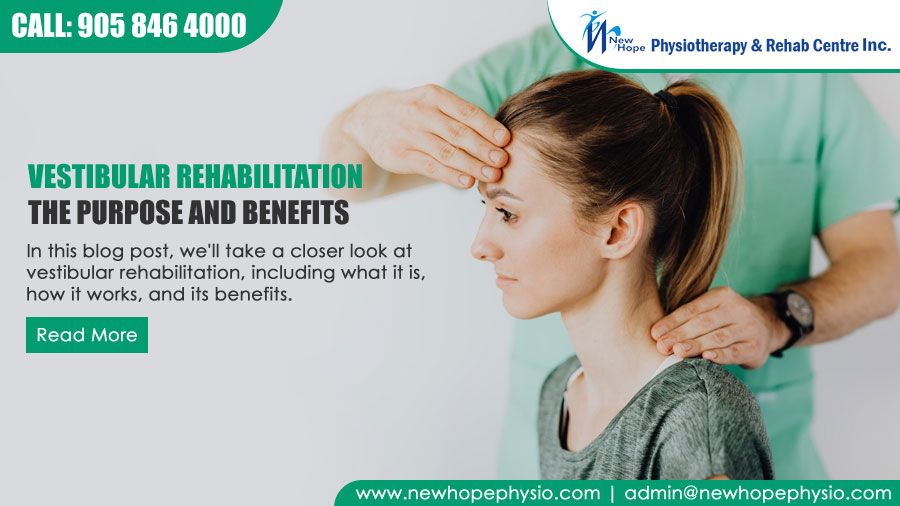
Vestibular Rehabilitation: Understanding the Purpose and Benefits
Do you feel dizzy when you turn your head? Does the room spin when you lie down or sit up? Do you struggle with balance and feel unsteady on your feet?
If any of this sounds familiar, you’re not alone — and you’re not imagining it. These are signs that your vestibular system may not be working properly. The good news is that vestibular rehabilitation can help — often dramatically.
Here’s everything you need to know, explained simply.
Also Read : 10 Gentle Workouts to Help Lower Back Pain at Home
What Is the Vestibular System?
Your vestibular system lives in your inner ear. It’s the part of your body responsible for:
- Keeping you balanced when you move
- Telling your brain where your body is in space
- Coordinating your eyes and head movements
- Helping you walk, turn, and move without falling
When it’s working well, you don’t even notice it. When something goes wrong with it, the effects can be debilitating.
Also Read: 5 Quick Home Remedies for Leg Cramp Relief and Prevention
What Is Vestibular Rehabilitation?
Vestibular rehabilitation is a specialised form of physiotherapy designed to treat problems with your vestibular system.
It uses targeted exercises and movements to retrain your brain and inner ear to work together properly again. Over time, this reduces or eliminates symptoms like dizziness, vertigo, and balance problems.
It is not:
- A quick fix or one-time treatment
- Painful or physically intense
- Only for older people
It is:
- A gradual, progressive programme tailored to you
- Delivered by a specially trained therapist
- Effective for a wide range of vestibular conditions
Who Can Benefit from Vestibular Rehabilitation?
Vestibular rehab helps people with a range of conditions. You may benefit if you have been diagnosed with — or are experiencing symptoms of:
| Condition | What It Causes |
|---|---|
| BPPV (Benign Paroxysmal Positional Vertigo) | Brief spinning episodes triggered by head movement |
| Vestibular neuritis | Inner ear nerve inflammation causing severe dizziness |
| Labyrinthitis | Inner ear infection causing vertigo and hearing changes |
| Concussion or TBI | Brain injury affecting balance and spatial awareness |
| Meniere’s disease | Episodes of vertigo, hearing loss, and ear fullness |
| Acoustic neuroma | A tumour on the vestibular nerve affecting balance |
| Age-related balance decline | Gradual loss of stability and increased fall risk |
| Multiple sclerosis | Neurological changes affecting balance and coordination |
The Main Types of Vestibular Rehabilitation Exercises
Your therapist will choose exercises based on your specific condition and symptoms. Here are the main categories:
1. 👁️ Gaze Stabilisation Exercises
These exercises train your eyes and head to work together more smoothly.
How it works:
- You focus on a stationary object
- You slowly move your head from side to side or up and down
- Your brain learns to keep your vision stable during movement
This is particularly helpful for people who feel dizzy when moving their head or reading while moving.
2. ⚖️ Balance Exercises
These retrain your body’s ability to stay stable in different positions and situations.
Examples include:
- Standing on one leg
- Walking heel-to-toe in a straight line
- Standing on a foam pad or unstable surface
- Moving in different directions while maintaining stability
These exercises challenge your balance system safely — building confidence and stability over time.
3. 🔄 Habituation Exercises
These exercises work by exposing you — in a controlled way — to the movements that trigger your dizziness.
How it works:
- You repeat the movement that causes symptoms
- Over time your brain learns to reduce its overreaction
- Symptoms gradually become less intense and less frequent
Think of it like gradually desensitising an allergy response — but for your brain and inner ear.
4. 🧮 Canalith Repositioning Manoeuvres
These are specific head and body movements used to treat BPPV.
What’s happening: In BPPV, tiny calcium crystals in your inner ear become displaced. They end up in the wrong canal and send confusing signals to your brain — causing vertigo.
The Epley manoeuvre and other repositioning techniques guide these crystals back where they belong. Many people experience immediate or rapid relief after just one or two sessions of this treatment.
Also Read: Shoulder Pain Solutions: 7 Essential Exercises for Quick Relief
5. 🏋️ Strengthening Exercises
Weak muscles contribute to poor balance. Strengthening the legs, core, and postural muscles gives your vestibular system better physical support.
These exercises help:
- Improve overall stability
- Reduce compensatory movements that cause strain
- Lower your risk of falls
6. 🌀 Motion Sensitivity Exercises
For people who feel sick or dizzy during everyday movements — like riding in a car or watching moving images — these exercises gradually reduce that sensitivity.
You’re exposed to controlled amounts of the triggering stimuli until your brain adapts and stops overreacting.
Also Read: How Does Physiotherapy Help with Vertigo and Dizziness?
The Many Benefits of Vestibular Rehabilitation
The impact of effective vestibular rehab goes well beyond just “less dizziness.”
🏃 Better Balance and Coordination
You move more steadily and confidently — reducing the exhausting effort of just staying upright.
🚫 Reduced Dizziness and Vertigo
Symptoms decrease in frequency and intensity. Many people see significant or complete resolution of their vertigo.
🛡️ Lower Risk of Falls
This is especially important for older adults. Falls are one of the leading causes of serious injury — vestibular rehab directly reduces that risk.
💊 Less Reliance on Medication
Many vestibular medications cause drowsiness and cognitive side effects. As rehab improves your function, many people find they need less medication.
🧠 Better Cognitive Function
The vestibular system is linked to attention, memory, and spatial awareness. Improving vestibular function often leads to sharper thinking and concentration.
😌 Better Mental Health
Chronic dizziness and balance problems cause anxiety, frustration, and often depression. Reducing symptoms has a powerful positive effect on mood and emotional wellbeing.
🧍 Better Posture
Balance problems often cause people to adopt compensatory postures that cause pain. Vestibular rehab improves posture naturally as balance improves.
😴 Better Sleep
Some vestibular conditions disrupt sleep. As symptoms are brought under control, sleep quality often improves significantly.
🏅 Better Sports Performance
Athletes with dizziness or balance issues can return to their sport with greater confidence and precision once vestibular function is restored.
What to Expect at Your First Vestibular Rehabilitation Session
Here’s a step-by-step look at how it typically works:
Step 1 → Comprehensive assessment
          Balance, coordination, eye movement,
          and vestibular function are all tested

Step 2 → Diagnosis confirmed
          The therapist identifies which part of
          your vestibular system is affected

Step 3 → Personalised programme created
          Exercises chosen specifically for
          your condition and symptom triggers

Step 4 → Treatment begins
          Exercises performed in clinic with
          therapist guidance and monitoring

Step 5 → Home programme given
          Exercises to practise daily between sessions

Step 6 → Regular progress reviews
          Programme adjusted as your function improves
Sessions typically last around an hour and occur once or twice a week, depending on your condition and needs.
How Long Does It Take to Work?
This is one of the most common questions — and the honest answer is: it varies.
| Condition | Typical Timeline |
|---|---|
| BPPV (uncomplicated) | Often 1–3 sessions |
| Vestibular neuritis | Several weeks to a few months |
| Concussion-related dizziness | Weeks to months depending on severity |
| Chronic balance problems | Several months of consistent work |
| Age-related balance decline | Ongoing maintenance programme |
Most people notice some improvement within the first few weeks. Significant and lasting improvement typically takes one to three months of consistent effort.
💡 Progress is not always linear. You may have good days and bad days during rehab. This is normal. Temporary increases in symptoms during exercises are often a sign that the therapy is working — not that something is wrong.
Possible Side Effects — What’s Normal
Vestibular rehabilitation is very safe. But some temporary side effects are common and expected:
- Dizziness during exercises — this is often the point. It’s how the brain learns to adapt.
- Fatigue after sessions — the exercises are mentally and physically demanding
- Mild headaches or neck ache — usually settles within a day
- Nausea — particularly during head movement exercises
- Temporary increase in symptoms — common in the early stages
These side effects are generally mild and pass quickly. Always tell your therapist what you’re experiencing so they can adjust your programme.
Tips for Getting the Best Results
Getting the most out of vestibular rehabilitation comes down to a few key habits:
- ✅ Do your home exercises daily — consistency is everything
- ✅ Be patient — progress takes time and isn’t always obvious week to week
- ✅ Communicate with your therapist — tell them what’s helping and what isn’t
- ✅ Challenge yourself gradually — small progressions add up to big improvements
- ✅ Make supportive lifestyle changes — reduce stress, limit caffeine and alcohol, prioritise sleep
- ✅ Stay positive — even small improvements are meaningful and worth celebrating
- ✅ Keep follow-up appointments — regular check-ins allow timely adjustments to your plan
Also Read: Frozen Shoulder vs. Rotator Cuff Tear: Key Differences and Symptoms
5 FAQs:
1. Is vestibular rehabilitation the same as regular balance training?
Not exactly. Regular balance training focuses on improving physical stability through strength and coordination exercises. Vestibular rehabilitation goes deeper — it specifically targets the inner ear and brain pathways responsible for your sense of balance and spatial awareness. It includes specialised techniques like gaze stabilisation and habituation exercises that aren’t part of standard balance training. If your dizziness or balance problems stem from a vestibular disorder, you need vestibular-specific rehabilitation — not just general balance work.
2. I’ve had dizziness for years. Is it too late for vestibular rehabilitation to help?
It’s rarely too late. Even people who have lived with chronic dizziness and balance problems for years can benefit significantly from vestibular rehabilitation. The brain retains a remarkable ability to adapt and compensate — a concept called neuroplasticity. That said, long-standing conditions may take longer to respond than more recent ones. The key is to start, stay consistent, and give your brain the time it needs to reorganise and improve.
3. Will the exercises make my dizziness worse before it gets better?
Possibly — and to some extent, that’s by design. Habituation exercises deliberately expose you to movements that trigger your symptoms, so your brain learns to stop overreacting to them. You may feel temporarily more dizzy during or right after some exercises. This typically settles within minutes and is a normal part of the process. Your therapist will calibrate the intensity carefully so that symptoms are provoked just enough to stimulate adaptation — without overwhelming you. Always report significant or prolonged worsening to your therapist.
4. Do I need a referral from a doctor to start vestibular rehabilitation?
In most cases, you can book directly with a physiotherapist who specialises in vestibular rehabilitation without a referral. However, it’s worth seeing your GP first if you haven’t already been assessed — particularly if your dizziness is new, severe, or accompanied by hearing loss, facial weakness, or sudden severe headache. These could indicate a more serious underlying condition that needs to be ruled out before starting rehabilitation. Once cleared, you can proceed with physiotherapy directly.
5. Can vestibular rehabilitation be done at home, or do I need to go to a clinic?
Both. Your initial assessment and the early stages of treatment are best done in a clinic with a trained therapist who can monitor your response and adjust your programme safely. Once you’ve learned the exercises correctly and your therapist is confident in your ability to progress, much of the ongoing work can — and should — be done at home. Daily home practice is actually one of the strongest predictors of success in vestibular rehabilitation. Many clinics now also offer telehealth follow-up appointments, which makes staying connected with your therapist much more convenient.
Also Read: 10 Safe Ways to Treat Neck Pain during Pregnancy
6. What is vestibular rehabilitation?
Vestibular rehabilitation is a type of physiotherapy that helps people with dizziness, balance problems, and vertigo. It uses simple exercises to improve balance, reduce dizziness, and help you move safely.
7. Who needs vestibular rehabilitation?
People who often feel dizzy, have vertigo, poor balance, or have trouble walking may benefit from vestibular rehabilitation. It is also helpful after inner ear problems, head injuries, or certain neurological conditions.
8. What conditions can vestibular rehabilitation treat?
Vestibular rehabilitation can help with:
- Vertigo
- Dizziness
- Balance disorders
- Benign Paroxysmal Positional Vertigo (BPPV)
- Vestibular neuritis
- Labyrinthitis
- Concussion-related dizziness
- Fall prevention
9. What happens during a vestibular rehabilitation session?
Your physiotherapist will assess your balance, eye movements, walking, and dizziness. They will create a personalized exercise program to improve your symptoms and help you regain confidence.
10. How does vestibular rehabilitation work?
The exercises train your brain to adjust to changes in the balance system. Over time, this helps reduce dizziness, improve coordination, and make daily activities easier.
11. How long does vestibular rehabilitation take?
The length of treatment depends on your condition. Some people feel better after a few sessions, while others may need several weeks of therapy for the best results.
12. Are the exercises safe?
Yes. Vestibular rehabilitation exercises are safe when guided by a trained physiotherapist. The exercises are designed based on your symptoms and comfort level.
13. Can vestibular rehabilitation help prevent falls?
Yes. Better balance and coordination can reduce the risk of falls, especially for older adults or people who feel unsteady while walking.
14. Can I do vestibular exercises at home?
Yes. Your physiotherapist may give you home exercises to practice every day. Doing these exercises regularly can help you recover faster.
15. What are the benefits of vestibular rehabilitation?
Vestibular rehabilitation can provide many benefits, including:
- Less dizziness and vertigo
- Better balance
- Improved walking and coordination
- Greater confidence during daily activities
- Reduced risk of falls
- Better quality of life
- Faster recovery from vestibular disorders
Final Thoughts
Dizziness and balance problems can take over your life in ways that people around you may not fully understand. The constant fear of spinning, the exhaustion of compensating for instability, the anxiety of not being able to trust your own body — it’s genuinely difficult.
Vestibular rehabilitation offers a real path forward. It’s not a quick fix, and it requires commitment. But for most people, it delivers meaningful and lasting improvement in symptoms — and with that, a genuine return to confidence, independence, and quality of life.
If dizziness or balance problems have been holding you back, talk to your doctor or book a consultation with a vestibular physiotherapist. You don’t have to keep living with it.
Also Read: What Should You Not Do After Cupping?
Leave a Comment